Ecological awareness and constant
preservation of the environment are also part
of the company's objectives. That is why Multinjet
takes special care with the water it uses during
the painting process.
During this treatment, all the solids that
could possibly be harmful to nature are removed
from the water and only then it returns to the
environment.
Our company has the following commitment: preserve
the quality of its products and at the same
time maintain the ecosystem's equilibrium.
Because Multinjet has as its
objective to manage and eliminate particles
and residues of paints that are harmful to the
environment, it created a filtering system for
these particles; they are deposited into a water
tank and then later eliminated from the filters
and in this way do not harm the environment.
These practices fulfill the procedures laid
out by the environmental legislations and result
in excellent performance due to the combination
of the equipment, products, and professionals
involved in the process. Multinjet is in perfect
equilibrium with the environment, employees,
and the community.
Check out the article
in the Magazine Plástico Moderno (Modern
Plastics), August 2005
Another complicated factor when talking about
plastic chroming is the environmental impact
the process produces. The process creates a
large quantity of liquid effluents, full of
heavy metals that need to be removed before
they can be discarded. The biggest problem is
the chrome. Traditionally, electroplates use
hexavalent chrome in the process of surface
treatment. This is a harmful substance to nature
and causes cancer affecting the health of the
employee involved in this process.
Metallization – This
environmental bottleneck stimulates the plastic
industry to find more alternatives than the
traditional solution of chroming, such as metallization.
This process does not use immersion in chemical
solutions as does electroplating. The metallization
process is accomplished through the application
of pre-varnish and thus is a safer method.
"This process does not harm the environment
and costs half the amount of the chroming process,"
states Valmor Mari, the commercial
director of Multinjet, a "gaúcho"
(southern Brazil) from Caxias do Sul who has
worked in this market niche since 1996.
Another advantage of metallization is the larger
range of plastics onto which it can be applied.
Other than ABS, this process can be used on
PVC, polypropylene, polystyrene, polycarbonates,
acrylic, and nylon. This process is being used
in applications for industries in the furniture,
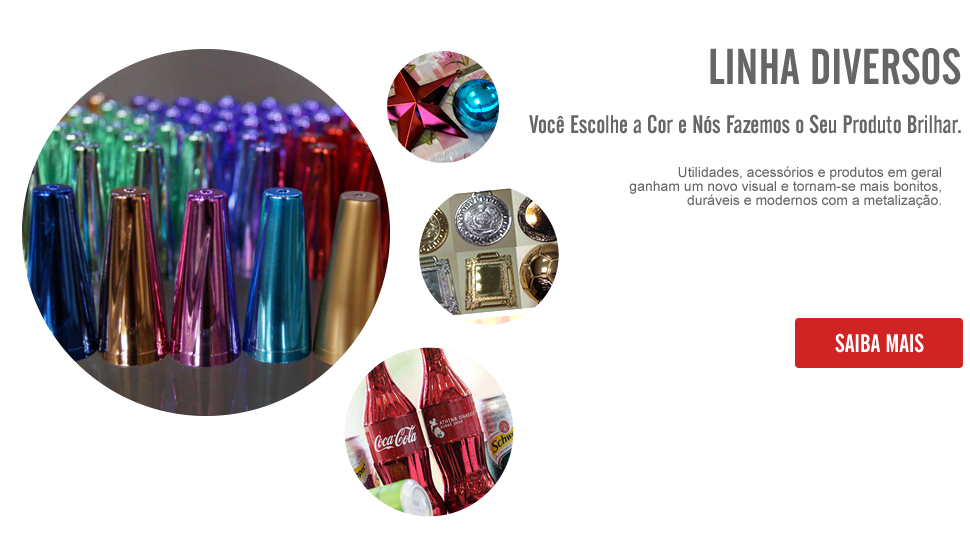
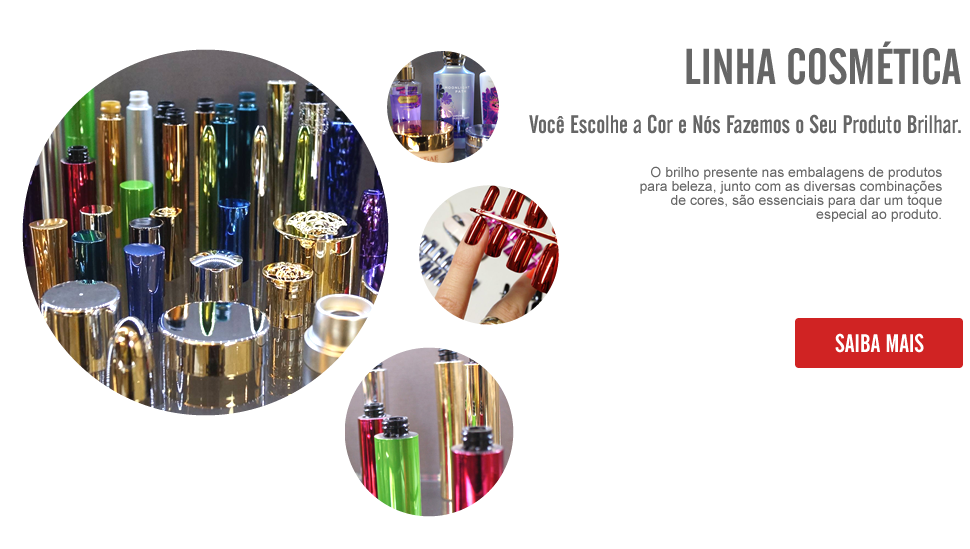
cosmetic, toy, and lighting segments.